Inspiration of Artist Edgar Miller
During the first half of the 20th century in Chicago, there developed a community of artists and designers whose work has become significant in the study of Modernism in America. This group, the Old Town Artists Colony, included such diverse talents as Carl Sandburg and Ben Hecht. Edgar Miller is probably one of the most distinguished and diversified of the visual artists of the group.
Edgar Miller’s artistic diversity is evidenced by the variety of media in which he worked. Stained glass, sculpture, graphic design, and murals are areas in which he is renowned. His work is also prolific in woodcarving, architectural design, watercolors, ceramics, painted china, and portraits.
Old Town in the late 1920s was a somewhat rundown German neighborhood of Victorian buildings. Today, it is greatly gentrified with cobblestone walks and trendy cafes. There are four buildings in this district that are quite remarkable little gems of architecture. Three of the buildings are modernized older structures; the remodeling began on all three in 1927. The fourth building was newly constructed in 1936.
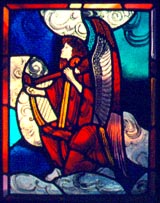
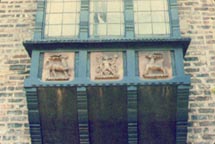
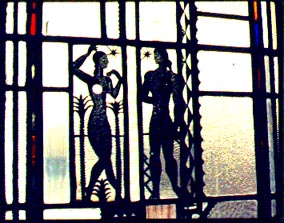
The buildings are architecturally unique, with enclosed courtyards, spiral stairways, stepped arches, and other spatial characteristics. There are striking embellishments inside and out. Mosaic tile, painted frescos, cast plaster, terra cotta, and carved wood are just a few of the decorative arts of these buildings. One of the most beautiful arts generously lavished upon these spaces is stained glass — everywhere, in every apartment and even along the corridors.
The three remodeled buildings were a collaboration of the talents of Edgar Miller and another artist, Sol Kogen. Miller served as the artist/designer and Kogen was the contractor/entrepreneur. In a recent conversation, Miller stated of this loose partnership that “the most pleasant aspect of working with Sol was that I could make any design statement I wanted and no question was raised.” These buildings are a 17-unit complex on Burton Place, a nine-unit complex on Wells Street, and a four-unit building on Cleveland Street.
The new building was a collaboration between Miller and architect Andrew Rebori. The Frank Fisher Apartments is an 11-unit building on North State Parkway. It was commonly held that Fisher Apartments were designed entirely by Rebori, but it is now known that Miller designed the façade and created the artworks, while Rebori was the architect for planning and construction.
Edgar Miller did a great deal of the work on these units in his spare time. He was working on a variety of projects for renowned architects such as Holabird and Root, Howard Van Doren Shaw, Samuel Marx, and Barry Byrne. Many of the artworks for the remodeled buildings were never paid for because, during the depression, money was scarce. Miller’s primary interest was to see these buildings come about and be successful.
The Stained Glass
The stained glass in these four buildings is unique. They represent Miller’s free hand in design and execution, having determined their placement as well as the design of the building in which they sit. There were no developers or committees constraining his creative impulses. This group of stained glass clearly shows a fresh approach to design, material application, placement, and pictorial composition.
The greatest portion of the stained glass for these buildings was made at Temple Art Glass Company on West Schiller Street, Chicago — responsible for fabricating much of the stained glass for Frank Lloyd Wright and other prairie school architects. Later works were done at Giannini and Hilgart, also in Chicago. Works completed since 1984 have been made at Zgoda’s stained glass atelier.
One of the most apparent aspects of Miller’s stained glass is that it is always made of transparent glass. Miller rejects the Tiffany style of opalescence and sentimentality. Modernism in the applied arts calls for positive statements in color and line. Antique and cathedral glasses offer positive color and the lead line is as bold a statement in line as can be made.
Transparent glasses also create wonderful kinetics in windows and light a room dramatically. The variety of ribbed and other textured glass can catch the light in a variety of ways so that a window changes as one moves past it or as objects move on the other side.
Miller studies the material of his craft and devises his own rules for maximum longevity. When planning designs, he also thinks as an engineer, making sure the lead network will provide sufficient support for the glass. He employs shapes that will withstand wind pressures and avoids long tapering ones that might easily crack.
His windows always observe the laws of architecture. They maintain transparency and the flatness of the wall. The colors are symbolic and the pictures iconographic. The designs are expressive and robust.
“For Edgar Miller, stained glass is a visual language. The pictures tell a story of the wondrous variety of the natural, living world. The composition expresses the vibrant nature of the human spirit. The glass celebrates life, especially the life of a wonderfully vital and gifted human being.”
Larry Zgoda, 1987
Published in Stained Glass Quarterly
Edgar Miller: 20th Century Renaissance Artist (PDF) — Fall 06/Winter 07